

Why Mid-Sized Manufacturers Often Hit Productivity Plateaus
Many mid-sized manufacturing businesses reach a point where manufacturing productivity improvement becomes difficult to achieve.
Production teams are working hard.
Investment is being made in equipment.
Customer demand may even be growing.
Yet factory productivity improvement stalls.
Operational challenges begin to appear across the factory:
-
Production bottlenecks that limit output
-
Labour productivity that fails to improve
-
Quality issues that repeatedly return
-
Factory layouts that no longer support efficient production flow
-
Managers spending more time firefighting than improving
For many manufacturing leaders, this creates a frustrating situation.
The business has strong potential, but operational performance is stuck.
Breaking through this plateau requires a more structured approach to manufacturing productivity improvement and manufacturing process optimisation.
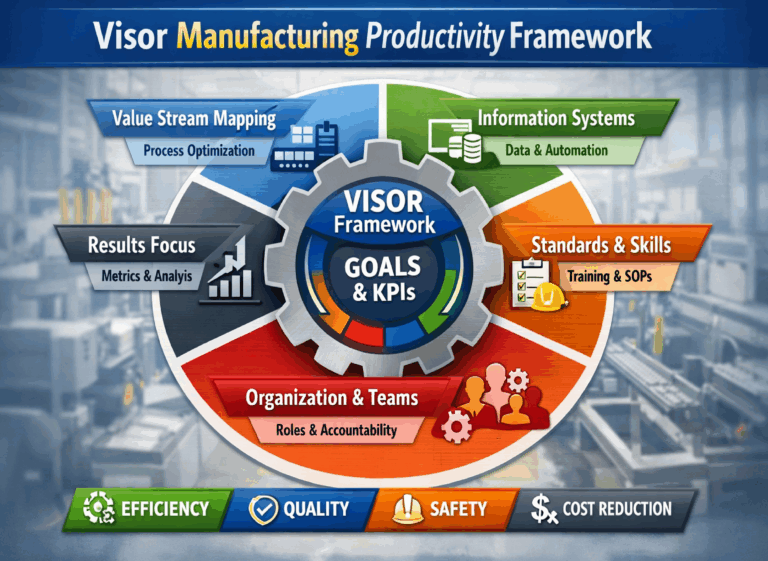
At Total Productivity Solutions, we support manufacturing leaders through structured factory productivity improvement programmes using the VISOR framework, a practical methodology designed to restore manufacturing operational efficiency and factory performance improvement.
Manufacturing Productivity Improvement in a VUCA Environment
Modern manufacturing businesses operate in conditions often described as VUCA:
-
Volatile supply chains and energy costs
-
Uncertain demand patterns
-
Complex production systems and product portfolios
-
Ambiguous signals about where to invest for growth
In these conditions, many organisations try to improve productivity through isolated initiatives. However, without a clear understanding of the overall production system, these initiatives rarely deliver lasting manufacturing operational efficiency improvements.
Sustainable factory productivity improvement requires a structured approach that identifies constraints, simplifies operations, and optimises the production system as a whole.
This is the purpose of the VISOR Framework.
The VISOR Framework for Manufacturing Productivity Improvement
The VISOR Framework is a structured methodology for manufacturing process optimisation and factory productivity improvement.
It provides manufacturing leaders with a clear pathway to diagnose operational challenges and implement sustainable manufacturing performance improvement.
V — Visualise: Understanding the Real Production System
The first step in manufacturing productivity improvement is to clearly understand how the factory actually operates.
Many factories operate with hidden inefficiencies that are difficult to see without structured analysis.
Visualisation techniques used in manufacturing process optimisation include:
-
Value stream mapping
-
Production flow analysis
-
Operational diagnostics
-
Factory layout assessment
These tools help identify:
-
Bottlenecks that restrict production capacity
-
Inefficient material flow
-
Labour productivity losses
-
Equipment constraints
Without this level of visibility, it is difficult to deliver meaningful factory productivity improvement.
I — Itemise: Identifying the Drivers of Operational Inefficiency
Once the production system is visualised, the next step in manufacturing productivity improvement is to break complexity into manageable elements.
Itemising the production system helps identify the true drivers of manufacturing operational inefficiency, including:
-
Labour utilisation challenges
-
Equipment performance issues
-
Production sequencing inefficiencies
-
Changeover losses
-
Material handling delays
This structured approach allows manufacturing leaders to focus on the areas where manufacturing productivity improvement will have the greatest impact.
S — Simplify: Removing Operational Complexity
Many factories accumulate unnecessary operational complexity over time.
Legacy procedures, redundant processes, and poorly designed workflows can significantly reduce factory productivity and manufacturing operational efficiency.
Simplification focuses on removing this friction by:
-
streamlining production processes
-
standardising work practices
-
reducing unnecessary process steps
-
improving operational consistency
In many manufacturing businesses, simplification alone can unlock significant factory performance improvement.
O — Ordinate: Optimising Factory Layout and Production Flow
Once operations are simplified, the next stage of manufacturing process optimisation is organising the factory around the optimal production flow.
This stage often includes:
-
redesigning factory layouts
-
improving production sequencing
-
balancing workloads across operations
-
improving material flow between processes
Effective factory layout optimisation is one of the most powerful drivers of manufacturing productivity improvement, particularly for mid-sized factories where layouts have evolved organically over time.
R — Resource: Investing in the Highest Impact Improvements
The final stage of the VISOR framework ensures that improvement initiatives are properly resourced.
Manufacturing organisations have limited time, capital investment, and engineering capacity. The Resource stage focuses these resources on the initiatives most likely to deliver measurable manufacturing productivity improvement and operational efficiency gains.
This creates a structured roadmap for factory productivity improvement and manufacturing business growth.
Supporting Mid-Sized Manufacturers to Unlock Productivity Improvement
Many mid-sized manufacturing businesses operate with limited internal resources dedicated to manufacturing process optimisation and operational engineering.
Production teams are focused on delivery.
Management teams are focused on growth.
However, without dedicated expertise in manufacturing productivity improvement, factories can remain stuck at the same performance level for years.
Working with an experienced manufacturing productivity consultant can help organisations:
-
identify operational constraints
-
redesign production processes
-
improve factory layouts
-
optimise labour productivity
-
unlock sustainable manufacturing operational efficiency
Manufacturing Productivity Consulting for Mid-Sized UK Factories
At Total Productivity Solutions, we specialise in supporting mid-sized manufacturing businesses across the UK with structured manufacturing productivity improvement and factory optimisation programmes.
Using frameworks such as VISOR and the TPS 5D methodology (Discover, Diagnose, Design, Deliver, Develop), we help manufacturing leaders:
-
diagnose operational inefficiencies
-
design more productive factory systems
-
implement practical productivity improvements
-
deliver measurable factory performance improvement
Our focus is always on practical engineering solutions that deliver real manufacturing productivity improvement.
Is Your Factory Stuck at Its Current Performance Level?
If your manufacturing operation has reached a productivity plateau, a structured manufacturing productivity improvement review can help identify the constraints and unlock the next stage of performance.
Call +44 (0)1980 669 610 to discuss your situation.
Or use the form below to book a Manufacturing Productivity Review.