

What happens when technology becomes more capable but people stop taking responsibility?
Artificial intelligence, automation, digital systems and increasingly connected workplaces are changing how organisations operate.
Knowledge workers can collaborate from almost anywhere. Information can be processed faster. Decisions can be supported by increasingly capable technology.
But manufacturing, engineering and other operationally intensive industries do not completely fit the work-from-anywhere model.
Factories still need people on the shop floor.
Engineering projects still need practical judgement.
Complex operations still need leaders who can bring people, processes, systems and technology together.
This raises an important question:
In a technologically enhanced workplace, how does an optimised person become more valuable?
Technology can process information, accelerate activity and extend human capability. But it cannot, by itself, create trust, accept responsibility or build an environment where people willingly solve problems and improve the systems around them.
That remains a human responsibility.
It is also one of the central ideas behind my book:
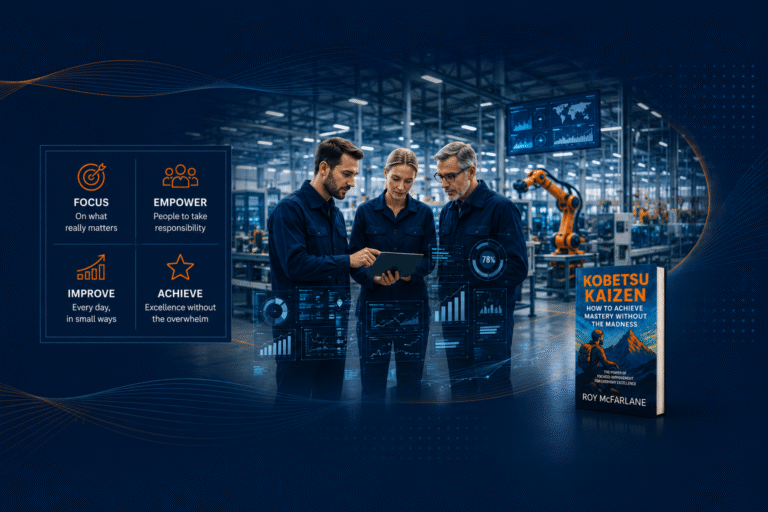
Why I Wrote Kobetsu Kaizen
Throughout my career in manufacturing, engineering, operational leadership and major project delivery, I have repeatedly seen capable people working inside environments that made success unnecessarily difficult.
People were busy.
Managers were under pressure.
Improvement projects were being launched.
Technology was being introduced.
Yet the same problems continued to return.
The issue was rarely a simple lack of effort or intelligence.
More often, the organisation had not created the conditions in which people could understand the purpose, exercise sound judgement, take responsibility and improve their work.
When responsibility remains concentrated in a small number of managers, those managers become overwhelmed.
Teams wait for decisions.
Problems are escalated instead of solved.
Firefighting becomes normal.
Eventually, the organisation becomes dependent on heroic effort merely to maintain everyday performance.
Kobetsu Kaizen explores a different approach.
It is based on the belief that sustainable success begins by creating an environment where responsibility, problem-solving and improvement become part of everyday work; and that this change must begin with the individual.
About the Book
The highest-performing organisations do not depend on extraordinary individuals. They create environments where ordinary people willingly take responsibility, solve problems and continuously improve.
If you are responsible for leading people, improving performance or delivering results in a complex organisation, you will recognise the challenge.
Every day starts with good intentions but can quickly become consumed by urgent emails, unexpected problems, competing priorities and constant firefighting. Improvement initiatives lose momentum, talented people become frustrated and leaders find themselves solving the same problems repeatedly.
It does not have to be this way.
After more than forty years of experience across manufacturing operations, engineering projects, business transformation and organisational improvement, I reached a simple conclusion:
Sustainable success is not achieved by working harder or introducing another management initiative. It comes from creating the right environment.
An environment where people understand the purpose, take ownership, make better decisions, solve problems at their source and continuously improve the systems around them.
Kobetsu Kaizen: How to Achieve Mastery Without the Madness is a practical guide to building that environment.
Drawing on real-world leadership and operational experience rather than abstract management theory, the book shares practical principles, personal stories and proven approaches for improving productivity, strengthening leadership, developing capable teams and creating lasting organisational improvement.
At the heart of the book is the VISOR Method™; a practical framework designed to help people simplify complexity, improve decision-making and create purposeful, sustainable progress.
What You Will Discover
The book explores how to:
- Create an environment where people willingly take responsibility and contribute to improvement.
- Replace constant firefighting with systems that support reliable performance.
- Solve recurring problems by addressing their causes rather than repeatedly treating symptoms.
- Develop leaders who coach, enable and strengthen others instead of becoming the answer to every problem.
- Build teams that think independently, collaborate effectively and learn from experience.
- Make better decisions when facing pressure, complexity and incomplete information.
- Lead organisational change while maintaining trust, engagement and momentum.
- Apply practical systems thinking to improve people, processes and performance.
- Develop the personal clarity, resilience and discipline required to lead meaningful change.
- Improve performance without creating burnout, unnecessary bureaucracy or dependence on heroic effort.
Who Is Kobetsu Kaizen For?
The book was written for people who carry responsibility in complex environments, including:
- Business and operational leaders
- Manufacturing and factory managers
- Engineering and technical professionals
- Project and programme managers
- Continuous improvement practitioners
- Supply chain and logistics leaders
- Business owners
- Graduates and emerging leaders
- Anyone seeking to improve how they think, lead and solve problems
Although many of the lessons were shaped through manufacturing and engineering, the principles apply wherever people, processes, systems and performance must work together.
A Short Extract from Kobetsu Kaizen
The strongest organisations are not built on control. They are built on people who understand the purpose, take responsibility for their actions and continuously improve the systems they influence.
Responsibility cannot simply be demanded.
It has to be supported by clarity, trust, capability and an environment in which people are encouraged to think.
That begins with leadership.
But before we can ask others to take greater responsibility, we must be willing to examine how our own thinking, behaviour and decisions shape the environment around us.
That is why meaningful organisational improvement starts with the individual.
An Optimised Person Brings a Competitive Advantage?
As technology becomes more capable, human contribution will not disappear. It will change.
Routine work may become increasingly automated.
Data may become easier to access.
AI may help people analyse problems, produce options and work more efficiently.
But organisations will still require people who can:
- Exercise judgement
- Understand context
- Accept responsibility
- Build trust
- Ask better questions
- Recognise unintended consequences
- Lead others through uncertainty
- Turn information into purposeful action
The technologically enhanced workforce will not make the optimised individual obsolete.
It will make clarity, responsibility, judgement and adaptability even more valuable.
Technology can amplify capability.
The environment determines how that capability is used.
About the Author
Roy McFarlane CEng is a Chartered Engineer, manufacturing optimisation specialist and Managing Director of Total Productivity Solutions Ltd.
His career has involved leading manufacturing operations, engineering projects, factory development, business improvement and organisational transformation across demanding operational environments.
His work combines practical engineering, systems thinking, people development and continuous improvement.
Kobetsu Kaizen brings together the practical lessons, personal experiences and leadership principles developed throughout that career.
It was not written to present another management fashion.
It was written to help people think more clearly, take meaningful responsibility and improve what matters, without losing themselves in the process.
Buy Kobetsu Kaizen
Kobetsu Kaizen: How to Achieve Mastery Without the Madness is available in Kindle app and hardcover editions through Amazon.
Buy Kobetsu Kaizen on Amazon UK
Bring These Principles into Your Organisation
The ideas explored in Kobetsu Kaizen also underpin the work of Total Productivity Solutions.
We help manufacturing and operational leaders understand complex systems, improve productivity, develop practical improvement strategies and create environments where people can take greater ownership of performance.
Where your organisation is experiencing constant firefighting, recurring problems, low ownership or stalled performance, a structured conversation may help reveal what is really preventing progress.
Discuss Your Organisation with Total Productivity Solutions
Final Thought
Lasting success does not come from having one exceptional leader carrying the organisation.
It comes from creating an environment where people at every level understand the purpose, take responsibility, solve problems and improve the systems they influence.
Technology may accelerate the journey.
People will still determine the destination.
Create the environment. Inspire ownership. Improve performance – starting with yourself.
Where to start
If you’re a leader who is looking for solutions for an increasingly complex manufacturing environment, call +44 (0)1980 669 610 to discuss your situation.
Or use the form below to book a Manufacturing Productivity Review.